Published by:
CGP EDU Academic Team
Published on: September 12, 2026
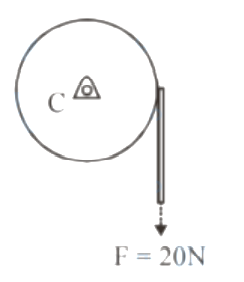
Consider a
uniform circular disk of radius
. It is pin supported at its center and is at rest initially.The disk is acted upon by a constant force
through a massless string wrapped around its peripheryas shown in the figure.
Suppose the disk makes
number of revolutions to attain an angular speed of
. The value of
, to thenearest integer, is____ [Given: In one complete revolution, the disk rotates by
]
Text Solution
Verified by ExpertsThe correct answer is:
A
Given:
- Radius of the disk, R = 0.2 m
- Force, F = 20 N
- Mass of the disk, M = 20 kg
- Final angular speed, \omega = 50 \text{ rad/s}
Step 1: Calculate the moment of inertia (I) of the disk.
Moment of Inertia of a solid disk about its center:
\[ I = \frac{1}{2} M R^2 = \frac{1}{2} (20)(0.2^2) = 0.4 \text{ kg m}^2 \]
Step 2: Calculate the torque (\tau) applied by the force.
Torque is given by: \[ \tau = F \times R = 20 \times 0.2 = 4 \text{ N m} \]
Step 3: Relate torque to angular acceleration (\alpha).
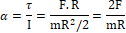
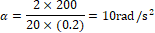
Using \[ \tau = I \alpha \Rightarrow \alpha = \frac{\tau}{I} = \frac{4}{0.4} = 10 \text{ rad/s}^2 \]
Step 4: Calculate the time (t) taken to reach the final angular speed (\omega) using \[ \omega = \alpha t \Rightarrow t = \frac{\omega}{\alpha} = \frac{50}{10} = 5 \text{ s} \]
Step 5: Calculate the total angle (\theta) covered in radians during this time period.
Using the equation of motion for angular displacement: \[ \theta = \frac{1}{2} \alpha t^2 = \frac{1}{2} (10) (5^2) = 125 ext{ rad} \]
Step 6: Find the number of revolutions (n) the disk completes:
Number of revolutions is given by: \[ n = \frac{\theta}{2\pi} = \frac{125}{2\pi} \approx 19.89 \]
Therefore, to the nearest integer, the number of revolutions n is approximately 20.
Therefore, the answer is approximately: A.
- Radius of the disk, R = 0.2 m
- Force, F = 20 N
- Mass of the disk, M = 20 kg
- Final angular speed, \omega = 50 \text{ rad/s}
Step 1: Calculate the moment of inertia (I) of the disk.
Moment of Inertia of a solid disk about its center:
\[ I = \frac{1}{2} M R^2 = \frac{1}{2} (20)(0.2^2) = 0.4 \text{ kg m}^2 \]
Step 2: Calculate the torque (\tau) applied by the force.
Torque is given by: \[ \tau = F \times R = 20 \times 0.2 = 4 \text{ N m} \]
Step 3: Relate torque to angular acceleration (\alpha).
Using \[ \tau = I \alpha \Rightarrow \alpha = \frac{\tau}{I} = \frac{4}{0.4} = 10 \text{ rad/s}^2 \]
Step 4: Calculate the time (t) taken to reach the final angular speed (\omega) using \[ \omega = \alpha t \Rightarrow t = \frac{\omega}{\alpha} = \frac{50}{10} = 5 \text{ s} \]
Step 5: Calculate the total angle (\theta) covered in radians during this time period.
Using the equation of motion for angular displacement: \[ \theta = \frac{1}{2} \alpha t^2 = \frac{1}{2} (10) (5^2) = 125 ext{ rad} \]
Step 6: Find the number of revolutions (n) the disk completes:
Number of revolutions is given by: \[ n = \frac{\theta}{2\pi} = \frac{125}{2\pi} \approx 19.89 \]
Therefore, to the nearest integer, the number of revolutions n is approximately 20.
Therefore, the answer is approximately: A.
Prepare Smarter with CGP Edu
Get practice questions, solutions, and test series in one place.
Write a Review
Share your experience with this question and solution.
Commentary
Send your comment, doubt, correction, or feedback to admin.
Similar Questions
Explore conceptually related problems
A uniform rod of length ‘ is pivoted at one of its ends on a vertical shaft of negligible radius. …
Four point masses, each of mass m, are fixed at the corners of a square of side . The square is ro…
As shown in the figure, a bob a mass m is tied by a massless string whose other end portion is woun…
The position vector of 1 kg object is and its velocity . The magnitude of its angular momentum is…
A stone tide to a string of length L is whirled in a vertical circle with the other end of the stri…
One end of a massless spring of spring constant k and natural length is fixed while the other end …